
Blog
Securing Rights: Data Privacy Law in Egypt

Egypt's data privacy landscape has entered a decisive new phase. With the activation of the Personal Data Protection Law (PDPL) No. 151 of 2020 through Executive Decree No. 816 of 2025, data protection is no longer a future obligation; it is an active legal requirement. As of January 2026, organizations operating in Egypt or handling data related to people in Egypt are subject to a fully enforced regulatory regime, with a final compliance deadline set for November 2026. [22]
Based on recent engagements and regulatory readiness assessments, Zerosploit has observed that many organizations still underestimate the operational impact of this shift. The PDPL is often viewed narrowly as a legal or compliance exercise, a perception that must change.
Shifting from Best Practice to Licensed Right to Operate
For years, the PDPL existed mainly on paper. While organizations were aware of its existence, enforcement mechanisms were limited. That changed with the executive regulations, which introduced clear procedures, licensing requirements, and penalties. Privacy in Egypt has now shifted from a "best practice" approach to a licensed right to operate. Organizations must obtain approval from the Personal Data Protection Center (PDPC) to legally process personal data. Unlike the EU's GDPR, which focuses on penalties after violations occur, Egypt's PDPL employs a preventive model.
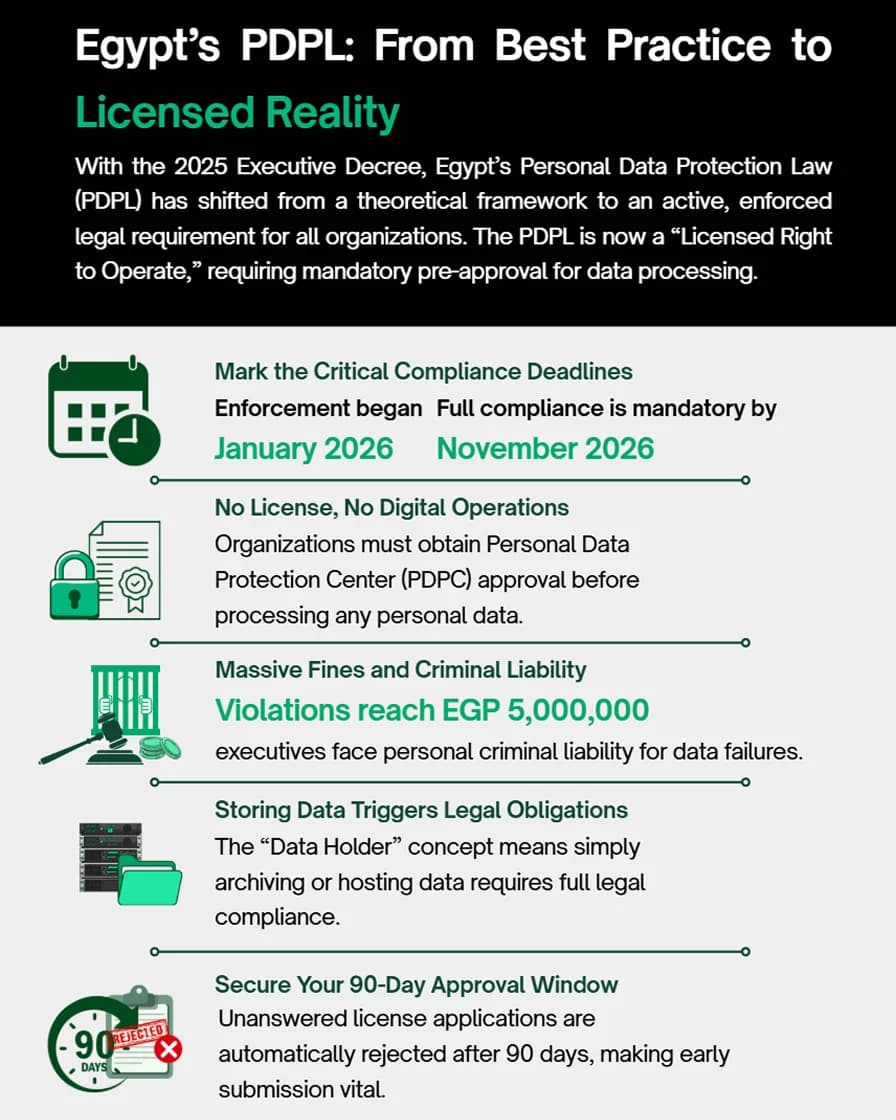
Data controllers, processors, and even entities that simply store data must register and, in many cases, obtain licenses before processing begins. Without PDPC approval, organizations risk being denied the right to operate digitally. This applies to local businesses and foreign companies alike if they process data related to individuals in Egypt.
Oversight, Sanctions, and Executive Accountability
Oversight of the PDPL is carried out by the Egyptian Data Protection Center (PDPC), which has broad authority to impose sanctions for non-compliance. Organizations that process personal data without obtaining valid consent may face fines ranging from EGP 100,000 to EGP 1,000,000. More serious violations, such as the unauthorized transfer of personal data outside Egypt, are subject to significantly higher penalties that can reach up to EGP 5,000,000.
The law also raises the stakes for leadership. Executives can face personal criminal liability for serious violations or failure to protect data. This makes data protection a board-level issue rather than a technical or legal task handled in isolation.
Strategic Drivers: Regional Hub and Data Sovereignty
The PDPL is driven by more than just domestic privacy concerns. Egypt is positioning itself as a regional hub for technology, outsourcing, and data centers. Strong data protection laws help attract foreign investment and enable cross-border business, especially with Europe. At the same time, the law reinforces data sovereignty by encouraging localization and controlling data transfers abroad.
Responding to the Growing Cyber Threat Landscape
The timing of enforcement reflects a growing threat landscape. Cyberattacks, ransomware, phishing, and digital scams have increased sharply. Egypt has been heavily targeted by spam calls and social engineering attacks, while ransomware groups have focused on high-value sectors such as telecoms, banking, and government services. The PDPL directly responds to these threats by requiring stronger security measures, tighter marketing controls, and rapid breach notification.
Key Features: Data Holder Concept and Sensitive Data
A unique feature of the law is the introduction of the "data holder" concept. Even entities that only store data, such as data centers or organizations with old archives, have legal responsibilities. Holding data alone is enough to trigger obligations to secure it. The law also classifies financial data and children's data as sensitive, placing higher protection requirements on FinTechs, insurers, healthcare providers, and digital platforms. Testing environments and legacy systems are not exempt; real data must be protected wherever it exists.
The Compliance Challenge: Beyond Legal Awareness
Complying with Egypt's PDPL goes beyond mere legal awareness. It requires practical security, governance, and operational controls that can withstand real enforcement. Many organizations struggle not with understanding the law, but with implementing it effectively across systems, processes, and teams.
Zerosploit, as a Level 1 Category certified cybersecurity service provider under NTRA regulation [23], helps organizations translate PDPL requirements into actionable controls supporting readiness assessments, governance frameworks, risk management, and incident response. By staying aligned with regulatory expectations as enforcement evolves, we enable organizations to reduce exposure, strengthen accountability, and operate with confidence in an increasingly regulated data environment.
In short, Egypt's data privacy framework is now fully operational. Organizations that adapt early will not only reduce legal risk but also gain trust in a growing digital market. Data privacy in Egypt is no longer optional — it is the law.